
Ghana has joined the global maritime community to mark World Maritime Day 2026, with stakeholders highlighting the need to translate international maritime policies and regulations into effective action.
The celebration, held in Accra on Thursday, 24 September 2026, was organised by the Ghana Maritime Authority (GMA)in partnership with the International Maritime Organization (IMO) under the theme, “From Policy to Practice: Powering Maritime Excellence.”
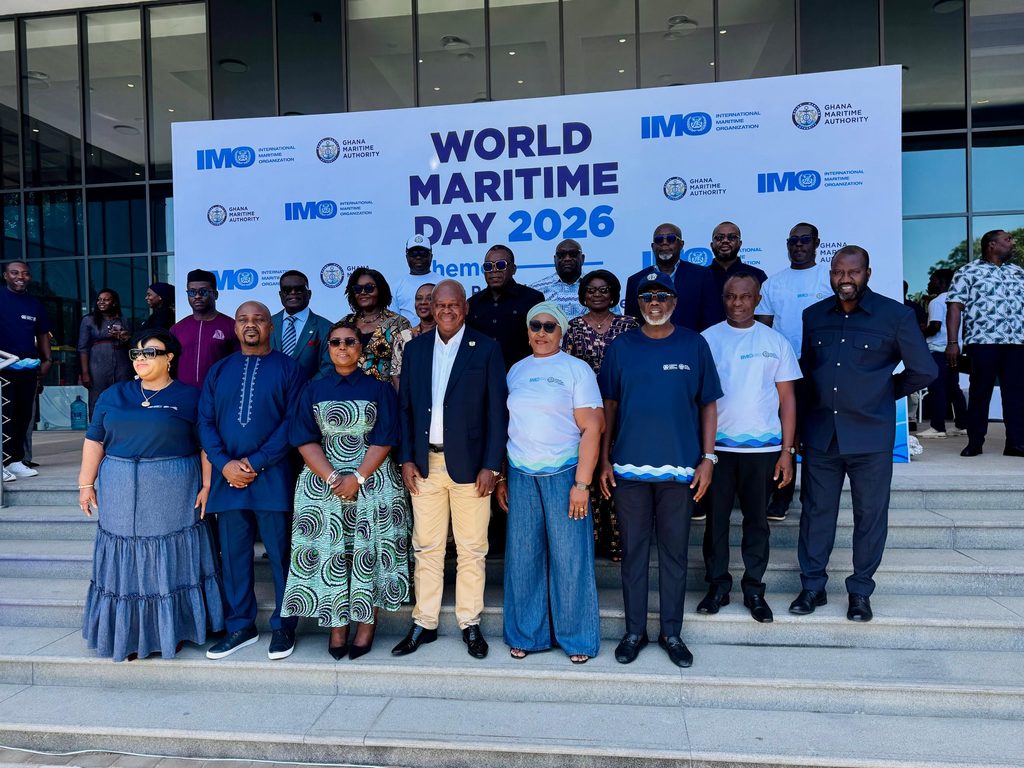
The event brought together the Minister of Transport, Joseph Bukari Nikpe, the Director-General of the Ghana Maritime Authority, Dr Kamal-Deen Ali, IMO representatives, members of the GMA Board, seafarers, maritime industry players, government representatives, development partners and academia.
In his opening remarks, Capt. Dallas Laryea, IMO Regional Coordinator for West and Central Africa – Anglophone, said the theme reflected the IMO’s focus on ensuring that international maritime regulations result in practical outcomes.
He said the effectiveness of maritime governance should not be measured only by the adoption of international conventions, but also by how well countries implement them through strong institutions, qualified personnel and sustained collaboration.
Capt. Laryea commended Ghana for its efforts in strengthening maritime administration, developing seafarers and embracing digital transformation.
He also highlighted the continued cooperation between the IMO and the Ghana Maritime Authority, including a sub-regional training programme on the assessment, examination and certification of seafarers held in Accra in August 2026.
According to him, the collaboration will continue with a regional workshop on the implementation of the Maritime Single Window, which is expected to support efficiency at the ship-port interface, facilitate trade and reduce administrative burdens.
Strengthening maritime governance
Dr Kamal-Deen Ali said the theme was particularly relevant to Ghana because the country’s maritime sector requires a strong legal and institutional framework to translate policy into effective practice.
He explained that Ghana’s maritime governance extends across its maritime space up to 200 nautical miles, requiring coordination between the Ghana Maritime Authority, the Ministry of Transport and other stakeholders.
He outlined a range of practical responsibilities undertaken by the Authority, including vessel safety, port state control, seafarer qualifications, cargo protocols, pollution prevention and maritime surveillance.
Dr Ali said Ghana’s maritime sector was experiencing significant growth, pointing to increasing volumes of cargo handled through the country’s ports.
He noted that port activity had already exceeded earlier projections of 1.8 million TEUs, with throughput expected to reach between 2.6 million and 2.7 million TEUs by the end of the year.
He attributed the growing activity partly to confidence in Ghana’s economy and the increasing use of the country’s ports by neighbouring countries.
The Director-General also disclosed plans to strengthen Ghana’s maritime domain awareness through enhanced surveillance capabilities.
He said the planned Maritime Safety and Security Coordination Fusion Center would further strengthen Ghana’s ability to monitor and respond to activities within its maritime space.
Infrastructure and opportunities for young people
Transport Minister Joseph Bukari Nikpe said the growth in cargo volumes had also created the need for corresponding investment in infrastructure to improve the movement of goods to and from the ports.
He said government was working on plans to expand the Tema Harbour Road and Tema arterial roads to ease congestion and improve access to the port.
The Minister also spoke about plans to connect rail services from the port to the Community Terminal, which he said would support the movement of containers and help reduce congestion.
Mr Nikpe further encouraged Ghanaian youth to take advantage of opportunities in the maritime sector, particularly through training at the Regional Maritime University (RMU).
He said the university, which evolved from the Ghana Nautical College, was established to train seafarers, captains and other technical professionals needed by the maritime industry.
He noted that the scale of global maritime trade meant there was a continuing demand for skilled personnel and urged young people to position themselves to benefit from opportunities within the sector.
From policy to practical implementation
The discussions at the celebration highlighted the broad scope of Ghana’s maritime industry, from regulation and safety to infrastructure, digitalisation, human-resource development and trade facilitation.
The event also featured an exhibition showcasing the work and activities of players within Ghana’s maritime industry, with dignitaries touring the exhibition area.
For the IMO and Ghanaian maritime authorities, the central message of the 2026 celebration was that effective maritime development requires more than policies on paper.
It requires the consistent implementation of international standards through capable institutions, skilled professionals, effective infrastructure and collaboration across the maritime sector.
